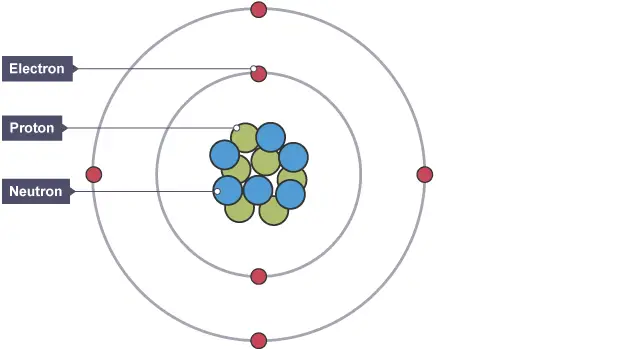
Education Science Materials: Atoms, Mixture and Solutions Quiz GastonJSeptember 27, 2025October 15, 2025 Welcome to your Materials: Atoms, Mixture and Solutions Quiz Name Class 1. What is the basic unit of an element that takes part in a chemical reaction? A. Molecule B. Atom C. Proton D. Electron None 2. The nucleus of an atom contains which subatomic particles? A. Protons and electrons B. Neutrons and electrons C. Protons and neutrons D. Only protons None 3. Which subatomic particle is negatively charged? A. Proton B. Neutron C. Electron D. Nucleus None 4. Where are electrons found in an atom? A. In the nucleus B. In shells around the nucleus C. Inside protons D. Between neutrons None 5. The number of protons in an atom is always equal to: A. The number of shells B. The number of electrons C. The number of neutrons D. The atomic mass None 6. Which subatomic particles cannot be shed or gained? A. Protons and neutrons B. Protons and electrons C. Neutrons and electrons D. Electrons only None 7. Why is an atom electrically neutral? A. Protons are heavier than electrons B. Neutrons cancel out protons C. Protons and electrons are equal but opposite in charge D. Neutrons are absent None 8. Which of the following has negligible mass? A. Protons B. Neutrons C. Electrons D. Nucleus None 9. What does the atomic number represent? A. Number of electrons + neutrons B. Number of protons in the nucleus C. Number of neutrons in the nucleus D. Number of energy shells None 10. What does the atomic mass number represent? A. Protons only B. Neutrons only C. Protons + Neutrons D. Electrons + Protons None 11. What is an ion? A. A neutral atom B. A charged atom C. A stable atom D. A neutron None 12. Which of the following ions is negatively charged? A. Cation B. Proton C. Anion D. Neutron None 13. Which of the following ions is positively charged? A. Electron B. Cation C. Anion D. Neutron None 14. Which statement is true about atoms and ions? A. Atoms have charges, ions do not B. Atoms are stable, ions are not C. Ions always have equal protons and electrons D. Atoms and ions are always colored None 15. What is a mixture? A. A pure substance B. A chemical reaction between two substances C. A physical combination of two or more substances D. A compound None 16. The components of a mixture can be separated by: A. Nuclear methods B. Physical methods C. Chemical reactions only D. None None 17. Which of the following is a solid + liquid mixture? A. Air B. Oil and water C. Salt in water D. Smoke2 None 18. Which of the following is a liquid + liquid mixture? A. Clay and sand B. Water and alcohol C. Air D. Dust in air None 19. What type of mixture is air? A. Solid–solid B. Solid–gas C. Gas–gas D. Liquid–gas None 20. Which type of mixture is foam mattress? A. Solid–solid B. Solid–gas C. Liquid–gas D. Gas–gas None 21. Which type of mixture has only one phase? A. Heterogeneous mixture B. Homogeneous mixture C. Suspension D. Colloid None 22. In which type of mixture can the constituents be seen? A. Solution B. Homogeneous C. Heterogeneous D. Colloid None 23. Salt and water is an example of: A. Heterogeneous mixture B. Suspension C. Homogeneous mixture D. Colloid None 24. In salt water, salt is the: A. Solvent B. Solute C. Solution D. Suspension None 25. The substance that dissolves other substances in a mixture is called: A. Solute B. Solvent C. Colloid D. Suspension None 26. Water is known as the universal solvent because: A. It dissolves only salts B. It dissolves many substances C. It cannot dissolve any gas D. It is always liquid None 27. Which factor speeds up the rate of dissolution? A. Large solute size B. Stirring and heating C. Cooling D. Lack of solvent None 28. Which of the following is a homogeneous mixture? A. Suspension B. Solution C. Colloid D. Sand and water None 29. Which type of mixture has particles that settle when left undisturbed? A. Colloid B. Solution C. Suspension D. Homogeneous None 30. Milk is an example of: A. Solution B. Suspension C. Colloid D. Homogeneous mixture None 1. The basic unit of an element that takes part in a chemical reaction is called an __________. 2. The nucleus of an atom contains __________ and __________. 3. The subatomic particle with a positive charge is the __________. 4. The number of protons in the nucleus of an atom is called the __________. 5. The total number of protons and neutrons in the nucleus of an atom is called the __________. 6. An atom that carries a charge is called an __________. 7. A positively charged ion is called a __________, while a negatively charged ion is called an __________. 8. A mixture in which the solute dissolves completely in the solvent to form a uniform combination is called a __________ mixture. 9. The substance that dissolves in a solvent is called the __________. 10. Milk, blood, and toothpaste are examples of a type of mixture called a __________. Time's up Time is Up! Share this post: Share on X (Twitter) Share on LinkedIn Share on Facebook Share on WhatsApp Share on Pinterest Share on Reddit Share on Telegram
Atoms and Mixtures Made Simple: Chemistry Notes for Students GastonJSeptember 25, 2025October 7, 2025