David Commits Adultery – Adult STS Lesson 240
“And David said unto Nathan, I have sinned against the LORD. And Nathan said unto David, The LORD also hath put away thy sin; thou shalt not die”
2 Samuel 12:13 (Memory Verse)
Introduction
David had been a great warrior from his youth and was suddenly shot into the limelight when he defeated Goliath, the Philistine giant. He maintained consistent victory over Israel’s enemies, even as he defeated the coalition of the army of the Syrians and Ammonites in the preceding chapter.
In the present texts, however, we see this valiant warrior being humiliated by an ugly, devouring, shameful enemy: his flesh. David yielded to the craving of his flesh and committed adultery with Bathsheba, Uriah’s wife, in violation of God’s commandment: “Thou shalt not commit adultery” (Exodus 20:14). Rather than repent, he rushed to hide it, perhaps for fear of public disgrace. Thus, he hatched different plots to cover up the evil act, which included getting rid of Bathsheba’s husband. He had forgotten that the Creator of the eyes sees everything we do and hears all our conversations (Psalm 94:9).
God sent the prophet Nathan to expose David’s schemes and pronounce divine judgment on him and his posterity for the evil acts. Believers need to learn that the flesh is a deadly monster that must be tamed constantly through grace and self-discipline so that the door of heaven would not be shut against them. The Apostle Paul said, “But I keep under my body, and bring it into subjection: lest that by any means, when I have preached to others, I myself should be a castaway” (1 Corinthians 9:27). David’s sin of adultery, his unsuccessful cover-ups, the wrath of God he incurred and his repentance are discussed in this study.
DAVID’S TEMPTATION AND FALL
2 Samuel 11:1-4; Proverbs 6:26; Genesis 3:1-7; 1 John 2:15-17; Matthew 4:1-7; 6:13; 26:41; Luke 4:13; 1 Corinthians 7:2; 10:13; 1 Timothy 6:9; Job 31:1
“And it came to pass, after the year was expired, at the time when kings go forth to battle, that David sent Joab, and his servants with him, and all Israel; and they destroyed the children of Ammon, and besieged Rabbah. But David tarried still at Jerusalem” (2 Samuel 11:1). There is something significant about this period: it was the time kings “go forth to battle”, but David chose to tarry at Jerusalem. This was a very costly mistake because there is a time and purpose for everything on earth. If the king had been in the right place at the right time, he would not have been a victim of Satan’s ploy to soil his testimony and garment of righteousness.
Rising from his bed at eventide and walking about on the housetop exposed the great warrior-king to a battle he never prepared for and, unfortunately, he lost out. This degrading defeat was not in the hands of enemy nations but from his own flesh. Adultery has been the undoing of many people: leaders, great men like Samson, Judah, Solomon and many contemporary believers. The Scripture warns against “…the lust of the flesh, and the lust of the eyes, and the pride of life…” (1 John 2:15-17). “For by means of a whorish woman a man is brought to a piece of bread: and the adulteress will hunt for the precious life” (Proverbs 6:26). Some careless believers have made a shipwreck of their faith because they failed to “…abstain from fleshly lusts, which war against the soul” (1 Peter 2:11).
Christ’s teaching on adultery reveals that the sin is actually committed before it happens in real life. He says, “…whosoever looketh on a woman to lust after her hath committed adultery with her already in his heart” (Matthew 5:28). In God’s reckoning, a man who lustfully gazes at the opposite sex is committing adultery even when he has not gone into fornication.
Things that incite and inflame the flesh are multiplying on many fronts in our society, especially with the advancement of modern technology. Pornography is a David’s kind of temptation: it catches people in an unguarded moment, like the rooftop. Live and still images of people litter social media and flash across the screens of laptops, tablets and cell phones. Pornography, the core of obscenity, is common in the mass media and on the Internet. But though it is becoming socially acceptable, it can never change God’s judgment on those who indulge in it.
Believers can overcome this monster through the sanctification experience, forsaking all appearances of evil, refraining from gazing at objects of temptation, reading and meditating on God’s word, praying for divine preservation and yielding or consecrating the members of our body entirely to the Lord. Job’s consecration was, “I made a covenant with mine eyes; why then should I think upon a maid?” (Job 31:1).
From David’s fall, believers must learn that:
- Satan is watching for their unguarded hour.
- There should be no place for loose living.
- The best of saints can be defeated after victory.
- A believer’s fall can have terrible consequences on himself and his posterity.
- The backslider should promptly repent instead of covering up sin.
- God still restores those who sincerely repent of sin.
DAVID’S ATTEMPT TO COVER UP SIN
2 Samuel 11:5-27; Proverbs 1:10; Ezekiel 33:12,13; Luke 13:1-3, 27; Proverbs 28:13; Psalm 32:3; 1 John 1:8
“And the woman conceived, and sent and told David, and said, I am with child” (2 Samuel 11:5). On hearing this, David planned to cover up his sin by plotting to kill her husband. He recalled him from the front with the pretext of showing concern for his welfare. The king instructed him to “Go down to thy house, and wash thy feet”, but the aim was to lead him to his wife so that the king’s mess would be covered. “And Uriah said unto David, The ark, and Israel, and Judah, abide in tents; and my lord Joab, and the servants of my lord, are encamped in the open fields; shall I then go into mine house, to eat and to drink, and to lie with my wife? as thou livest, and as thy soul liveth, I will not do this thing” (2 Samuel 11:11). Like Uriah, members of the church should maintain their consecration to the Lord. Uriah’s self-control (which the king lacked) was a strong rebuke of the king’s betrayal and sin.
Having failed in his first cover-up effort, the king made a second try by making Uriah drunk, hoping to cause a disputed paternity of the child. This design also failed. Lastly, he sent a letter through Uriah to Joab, the army commander, to set the former up to be killed. Thus, Joab became an accomplice in the death of Uriah. “And there fell some of the people of the servants of David; and Uriah the Hittite died also” (2 Samuel 11:17). David deliberately caused Uriah’s death. After that, he sent and took Bathsheba to be his wife (2 Samuel 11:27).
The journey into sin and backsliding goes from one level of degradation to another. When sinners attempt to cover up sin instead of repenting, more sins are committed. David added murder, covetousness, hypocrisy and criminal conspiracy to his adultery, all because he failed to repent promptly. “But the thing that David had done displeased the LORD.” His fall was a decline in his life, family, nation and ministry. Things were never the same for him after this dastardly act. Believers are warned to “Abstain from all appearance of evil” (1 Thessalonians 5:22).
DIVINE JUDGMENT FOR SIN AND DAVID’S PENITENCE
2 Samuel 12:1-31; Psalm 51:1-17; Romans 6:23; 2 Samuel 5:10; Ecclesiastes 12:14; Romans 10:12; Jeremiah 3:12,13; Proverbs 28:13; Ezekiel 18:23,32; 33:11
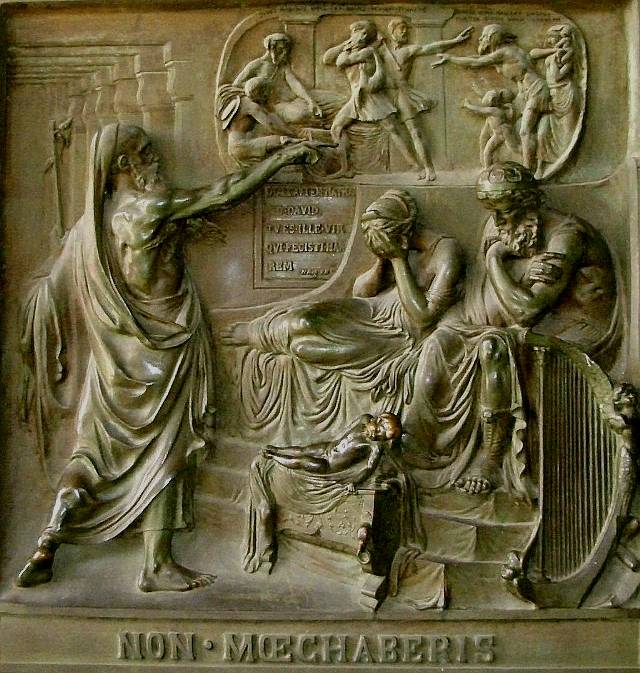
God sent the prophet Nathan to David after the child was born to reveal his sin and the accompanying judgment. Nathan presented a parable of the merciless act of a rich man who took the only lamb of his poor neighbour to entertain his own guest. David responded in anger and demanded a fourfold restitution for being so merciless, including a death sentence on the anonymous offender, not knowing that he was actually the man (2 Samuel 12:7). Like Nathan, believers must faithfully declare the divine message without fear or favour so that it can yield the desired fruit of repentance in others.
Nathan also declared the grievous judgment of God: “Thus saith the LORD God of Israel, I anointed thee king over Israel, and I delivered thee out of the hand of Saul; And I gave thee thy master’s house, and thy master’s wives into thy bosom, and gave thee the house of Israel and of Judah; and if that had been too little, I would moreover have given unto thee such and such things. Wherefore hast thou despised the commandment of the LORD, to do evil in his sight? thou hast killed Uriah the Hittite with the sword, and hast taken his wife to be thy wife, and hast slain him with the sword of the children of Ammon. Now therefore the sword shall never depart from thine house; because thou hast despised me, and hast taken the wife of Uriah the Hittite to be thy wife. Thus saith the LORD, Behold, I will raise up evil against thee out of thine own house, and I will take thy wives before thine eyes, and give them unto thy neighbour, and he shall lie with thy wives in the sight of this sun. For thou didst it secretly: but I will do this thing before all Israel, and before the sun. And David said unto Nathan, I have sinned against the LORD. And Nathan said unto David, The LORD also hath put away thy sin; thou shalt not die. Howbeit, because by this deed thou hast given great occasion to the enemies of the LORD to blaspheme, the child also that is born unto thee shall surely die” (2 Samuel 12:7-14). God is holy and just in His judgments; He hates sin in all its ramifications. Anyone who toys with it will definitely incur His wrath, irrespective of position, social status, or political or religious title.
When David told Nathan, “I have sinned against the LORD”, he did the right thing. Christians should learn to accept responsibility for their conduct and, if in error, admit it and repent promptly. This is because every unpardoned sin, hidden or open, shall be judged. “For God shall bring every work into judgment, with every secret thing, whether it be good, or whether it be evil” (Ecclesiastes 12:14). David’s wholehearted repentance and earnest prayer for mercy and restoration is recorded in Psalm 51 as a model for every sinner or backslider on how to reconnect with God and be restored to His favour.
From the eventual repentance of David, we learn, first, that every secret sin is an open scandal before God. What he tried to cover up with the death of Uriah was not hidden from God. Second, “Though hand join in hand, the wicked shall not be unpunished” (Proverbs 11:21). God will always punish unconfessed sin, no matter the pedigree of the sinner, because He is not a respecter of persons. Third, secret sins eventually leave open scars. What David covered up for close to a year eventually became a scandal that affected many of his children.
It is important for believers to know, however, that the hope and promise of forgiveness is no licence to sin. Apart from our ignorance of the length of our life and of when the rapture will take place, the scars that follow a pardoned sin, as we see in this study, might be too heavy a price to pay.
As a king, it was commendable on David’s part that he eventually humbled himself before God for his sins. He acknowledged his fault, unlike many who deny their errors with empty boldness when they are confronted. Instead of humility and genuine repentance, many choose to bluff their way through blatant lies.
The closing verses of the texts carry mixed blessings. The child of the adultery, whose life David sought to preserve, died under divine displeasure, though a second son was born to David by Bathsheba, whom David named Solomon, a name meaning “man of peace” in view of God’s promised reign of peace and the peace David obtained following his restoration. God also sent Nathan to give Solomon a second name, “Jedidiah”, which means “beloved by Jehovah”.
That this son would eventually take the seat of David reminds us of the amazing grace of God that turned an unmerited chapter in the life of David into a story of genuine repentance, plea for mercy and faith in Christ (1 John 2:1,2). Besides the victory over sin, there was also the conquest of Rabbah, the city of the children of Ammon, by David’s army.
Questions for Review
- Identify the enemy that conquered David in the text.
- In what areas should believers watch against immorality?
- Explain Christ’s teaching on adultery and how believers can overcome this evil.
- What are the consequences of attempting to cover up sin?
- How can a believer maintain continuous victory over sin, self and Satan?
- What is the place of humility in genuine repentance?
- What does God expect all sinners to do?